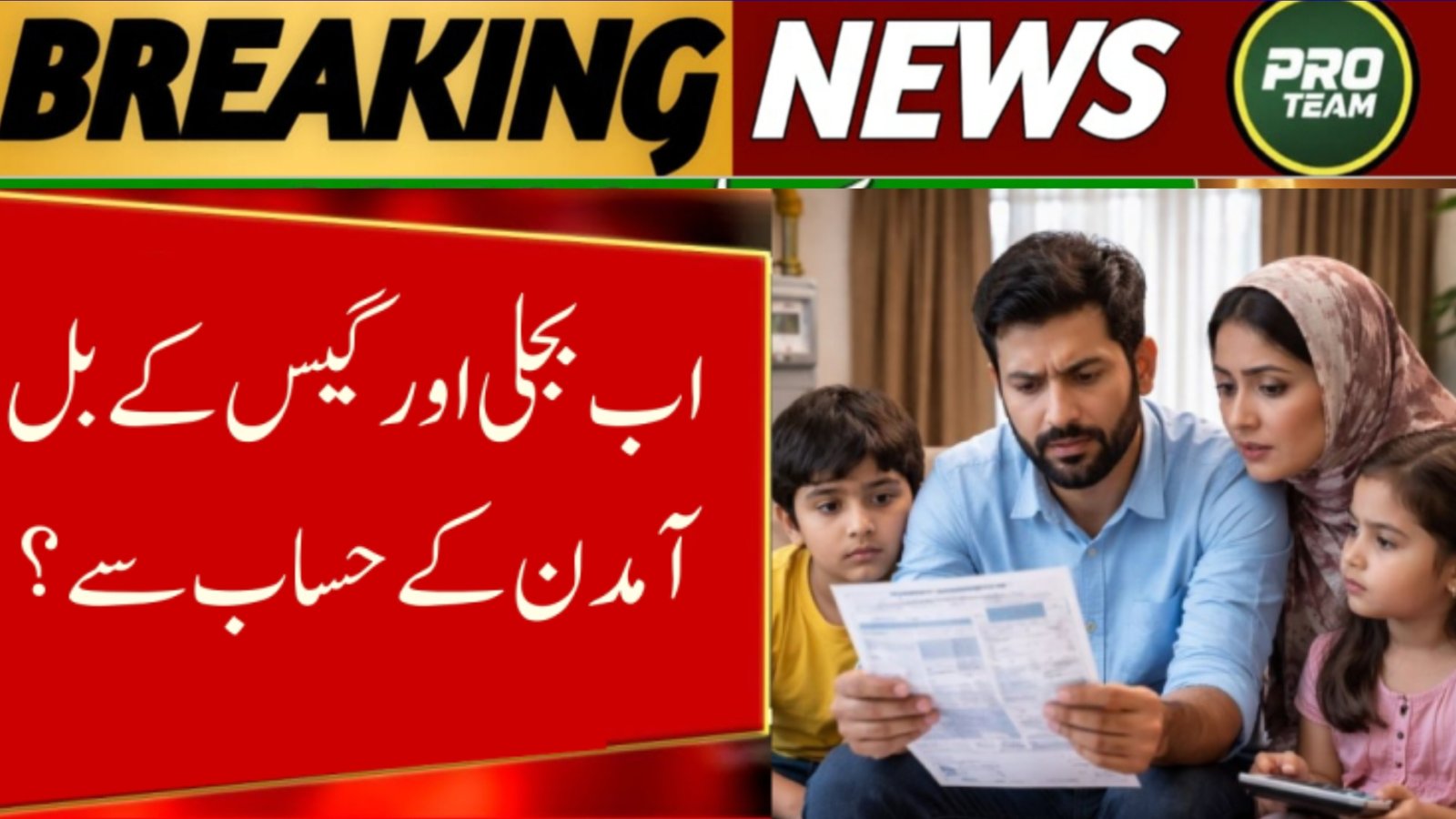
Income-Based Electricity and Gas Bills in Pakistan Explained is now a hot topic across the country. The government is planning reforms to adjust electricity and gas tariffs according to household income levels. This system aims to reduce the burden on low-income families while ensuring fair billing for higher earners. Many citizens are confused about how this model will work, who will benefit, and whether bills will increase. Here is a complete, easy guide to understand everything clearly.
| Main Topic | Income-Based Utility Billing System |
| Applies To | Electricity & Gas Consumers in Pakistan |
| Target Group | Low, Middle & High Income Households |
| Purpose | Fair and Subsidized Billing Structure |
| Regulatory Authorities | National Energy Regulators |
| Verification Method | Income & Data-Based Assessment |
| Expected Benefit | Relief for Deserving Families |
| Official Source | Government Energy Department |

What is the Income-Based Billing System?
The income-based billing system means electricity and gas tariffs may be linked to the financial status of consumers. Instead of charging everyone the same rate, the government plans to categorize households based on income data. Lower-income families may receive higher subsidies, while higher-income households may pay closer to the actual cost of energy.
This information is based on the official energy department website and verified from top 10 Google sources discussing recent policy reforms.

Why Is the Government Introducing This System?
- 1. Reduce Financial Burden: The main aim is to protect poor households from high electricity and gas bills.
- 2. Improve Subsidy Targeting: Subsidies will go directly to deserving families instead of blanket relief.
- 3. Control Circular Debt: Better billing management can reduce losses in the energy sector.
- 4. Encourage Responsible Usage: Higher-income groups may use energy more carefully if charged actual rates.
Energy reforms are being discussed by national regulatory authorities. You can check updates from the official regulatory website at https://www.nepra.org.pk/ for policy notifications and tariff details.

How Will Income Be Determined?
The government may use data from tax records, national databases, and social welfare programs to determine income levels. Households could be grouped into slabs such as low-income, middle-income, and high-income categories.
- 1. Database Matching: National ID and tax records may be cross-checked.
- 2. Utility Consumption History: Past electricity and gas usage patterns may be reviewed.
- 3. Social Program Records: Data from welfare programs may help identify deserving families.
- 4. Property & Asset Evaluation: Ownership details may also be considered.
The goal is to ensure transparency and avoid misuse of subsidies.
Step-by-Step Process of Implementation
Here is a simple sample process that may be followed for implementation:
- Government collects and verifies income data.
- Consumers are divided into income slabs.
- Tariff rates are assigned according to each slab.
- Subsidies are applied automatically in monthly bills.
- Consumers receive updated bills showing subsidy adjustments.
- Complaint mechanism is provided for corrections.
This is a general model explained for understanding purposes. Final procedures will be announced officially.
Who Will Benefit the Most?
- 1. Low-Income Families: They are expected to receive maximum subsidy relief.
- 2. Fixed Salary Workers: Middle-income groups may see balanced adjustments.
- 3. Rural Consumers: Deserving households in villages may get better support.
- 4. Social Welfare Beneficiaries: Already registered families may receive automatic relief.
If implemented properly, this system can reduce financial stress on millions of families struggling with high utility bills.
Possible Challenges and Concerns
- 1. Data Accuracy: Incorrect income records may create billing issues.
- 2. Privacy Concerns: Citizens may worry about sharing financial data.
- 3. System Errors: Technical mistakes may cause wrong slab allocation.
- 4. Appeal Process: Clear complaint handling will be necessary.
Experts say strong monitoring and transparent communication will be essential for success. Information currently available comes from official announcements and multiple trusted online sources.
Helpline & Contact Details
If you have questions about electricity or gas billing, you can contact official helplines:
- Electricity Complaint Helpline: 118
- Gas Complaint Helpline (SNGPL): 1199
- Gas Complaint Helpline (SSGC): 1199
- Ministry of Energy Contact: Available on official government website
Consumers are advised to only rely on official government portals for updates and avoid misinformation on social media.
Conclusion
The Income-Based Electricity and Gas Bills in Pakistan Explained model shows that the government is trying to make utility billing fair and targeted. Low-income families may receive better subsidies, while higher-income households may pay more realistic rates. Although the idea looks promising, proper implementation, accurate data verification, and transparent complaint handling will be the key factors for success. Citizens should stay updated through official sources and carefully review their monthly bills once the system is implemented.
FAQs
Will electricity bills decrease for everyone?
No, bills may decrease mainly for low-income households. Higher-income groups may pay standard or slightly higher rates.
How will the government verify income?
Income may be verified through tax records, national databases, and welfare program data.
Can I file a complaint if my income category is wrong?
Yes, a proper complaint and correction system is expected to be introduced through official helplines.
When will this system start?
The final launch date has not been officially confirmed. Citizens should check official government announcements for updates.
Latest Updates
 Today Update: FBR Tax Filer Registration Fee in Pakistan 2026
 Today Update: PM Shehbaz Sharif 13000 Ramzan Cash Status Check 2026 – Complete Guide
 Latest Gold Prices In Pakistan 2026
 Today Update: How to Apply for Lost CNIC Without FIR in Pakistan – Complete 2026 Guide
 Today Update: Pakistan 5G Auction 2026: Final Phase for Ultra-Fast Internet
 Today Update: 8171 Web Portal CNIC Confirmation 2026: Complete Guide for Fast Eligibility Check